| Industry | Waste Management |
| Application | Front Loader Trucks |
| Scale of Project | ~200 Vehicles |
| Location | Nationwide, Mexico |
| Authorized Partner | ADFS (Advanced Fire and Security Solutions) |
| Value of Protected Assets | $40M USD in assets protected |
Following a year-long evaluation that included live fire demonstrations with public safety officials present, one of Mexico's largest waste collection companies selected Firetrace to protect more than 200 front-loader trucks operating across Mexico. The fleet had been experiencing fires — particularly in the extreme heat of northern cities like Mexicali and Tijuana — resulting in multiple complications and expenses in paperwork, repairs, but above all, in operational downtime. Since deploying Firetrace, trucks suppress fires in under 10 seconds, often before operators are even aware an incident occurred.
_____________________________________________________________________________________________________________________________________________________
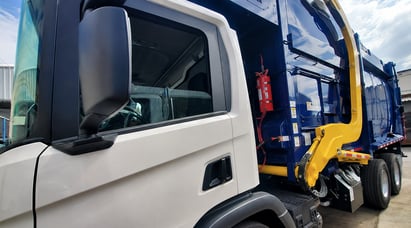
Front-loader trucks are among the most fire-prone vehicles in a waste collection fleet. The design of the truck, paired with nature of the work, creates the risk: the engine sits beneath the cab, by the space where the compactor box meets the hydraulic lifting system. Improperly disposed of trash and debris by the public leads to mixture of flammable materials that accumulate in that zone during normal operation.
In northern Mexico, the problem is compounded by temperature. Mexicali can reach 50°C (122°F), one of the highest ambient temperatures in the country. At those levels, the combination of accumulated debris, operational use, hydraulic fluid, and heat creates conditions where a fire can occur.
When a front loader truck catches fire in service, standard protocol can include raising the compactor box and dumping the trash load into the street. That burning debris can then damage pavements, nearby vehicles, and surrounding infrastructure. Authorities arrive and the truck can be impounded while an investigation determines liability.
What follows is a cascade of costs most companies can’t afford to ignore:
Each front loader in this fleet carries a replacement value of approximately 4 million Mexican pesos — around $200,000 USD. When considering the total cost of a single fire event: repairs, downtime, and legal expenses can quickly equal or surpass the original truck value — and that's before factoring in the longer-term insurance and reputational impact.
_____________________________________________________________________________________________________________________________________________________
The decision to install Firetrace took an evaluation process of over a year.
The turning point came during a live fire demonstration conducted in Monterrey, the company's headquarters city. Public safety officials, civil protection authorities, and firefighters were all present. A Firetrace system was installed on a front loader exactly as it would be deployed in real service. Fire was set in the target zone. The system discharged. The fire was out.
"Seeing the equipment work in real conditions — that was the most important factor in the decision."
— Oscar González Landín, General Director, ADFS
Firetrace was chosen for its core capabilities, which are uniquely suited to mobile vehicle applications:\
Fully autonomous — no batteries, no electrical connection required
_____________________________________________________________________________________________________________________________________________________
The project began in 2018 with an initial purchase order of 80 front loaders, concentrated in the northern states where fire incidents were most frequent. Assembly took place primarily in Monterrey and Puebla — the two cities where the client builds out their trucks before deploying them nationally.
Today, more than 200 trucks across Mexico carry Firetrace systems. The fleet spans the length and width of the country, from the northern border cities to central Mexico.
Fleet operators considering fire suppression often worry about installation downtime. The deployment of this project addressed that directly.
Installations were scheduled around the client's operational calendar often during nights and weekends. ADFS coordinated with fleet operations, maintenance teams, and workshop schedules to ensure each vehicle was available before a technician arrived.
On new trucks entering the fleet, the Firetrace system is always the last component installed — after the compactor box, electrical systems, and paint — ensuring no subsequent maintenance work disturbs the suppression system before the truck goes into service.
"The system puts fires out in less than 10 seconds. The truck simply continues to run."
— Oscar González Landín, General Director, ADFS
WHAT GET'S PROTECTED
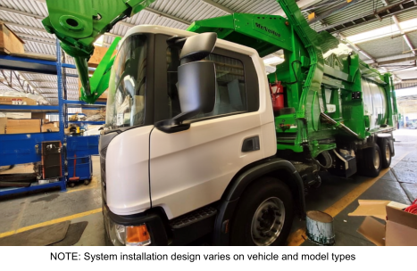
Each installation is engineered to the specific risk profile of the vehicle. In this application, the primary protection zone is the space between the cab and the compactor box — where trash, heat, and hydraulic fluid converge above the engine. That is where fires were occurring.
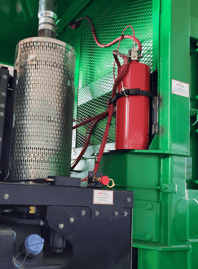
Each truck's system includes a suppression tank mounted to the back of the compactor box, detection tubing routed along the walls of the target zone, and nozzles directed at the engine bay and battery.
_____________________________________________________________________________________________________________________________________________________
The results of this deployment were operational, financial, reputational, and safety-related.
| Asset Protection | Each front loader carries a replacement value of ~$200,000 USD. Firetrace protects that asset automatically. |
| Operational Continuity | Trucks stay on the road. Fire events in protected area are suppressed in seconds — often before operators are aware. |
| Legal Exposure Reduced | Preventing a fire prevents the impoundment process, public property liability, and government investigations. |
| Insurance Impact | Fewer fire incidents means a more favorable risk profile and reduced pressure on premiums. |
| Operator & Public Safety | Suppression happens automatically — no action required from the driver. Communities are protected too. |
The investment has become a demonstration of responsible operations to municipal governments and regional authorities.
_____________________________________________________________________________________________________________________________________________________
Firetrace is the market leader in focused fire suppression for vehicle and industrial applications. The technology is autonomous and responds faster than any human intervention could. In a competitive market that increasingly includes lower-cost alternatives, customers choose Firetrace for its proven performance and industry longevity.
For end users evaluating fire suppression for their vehicle fleets, the math is straightforward. One fire event — with its associated downtime, legal exposure, insurance complications, and asset loss — can cost more than protecting the entire fleet from the start.
The question isn't whether you can afford to install Firetrace. It's whether you can afford not to.
_____________________________________________________________________________________________________________________________________________________

Advanced Fire and Security Solutions (ADFS) is a trusted Firetrace partner that installs and services automatic fire suppression systems across Mexico.

Javier Gonzalez Landin – CEO
info@adfsglobal.com | 800-077-2629